Press & Media
Logging Rolls at 38,000 Feet: A Pilot’s Mat Passport
By Lion — airline pilot and everyday grappler based in Bangkok.
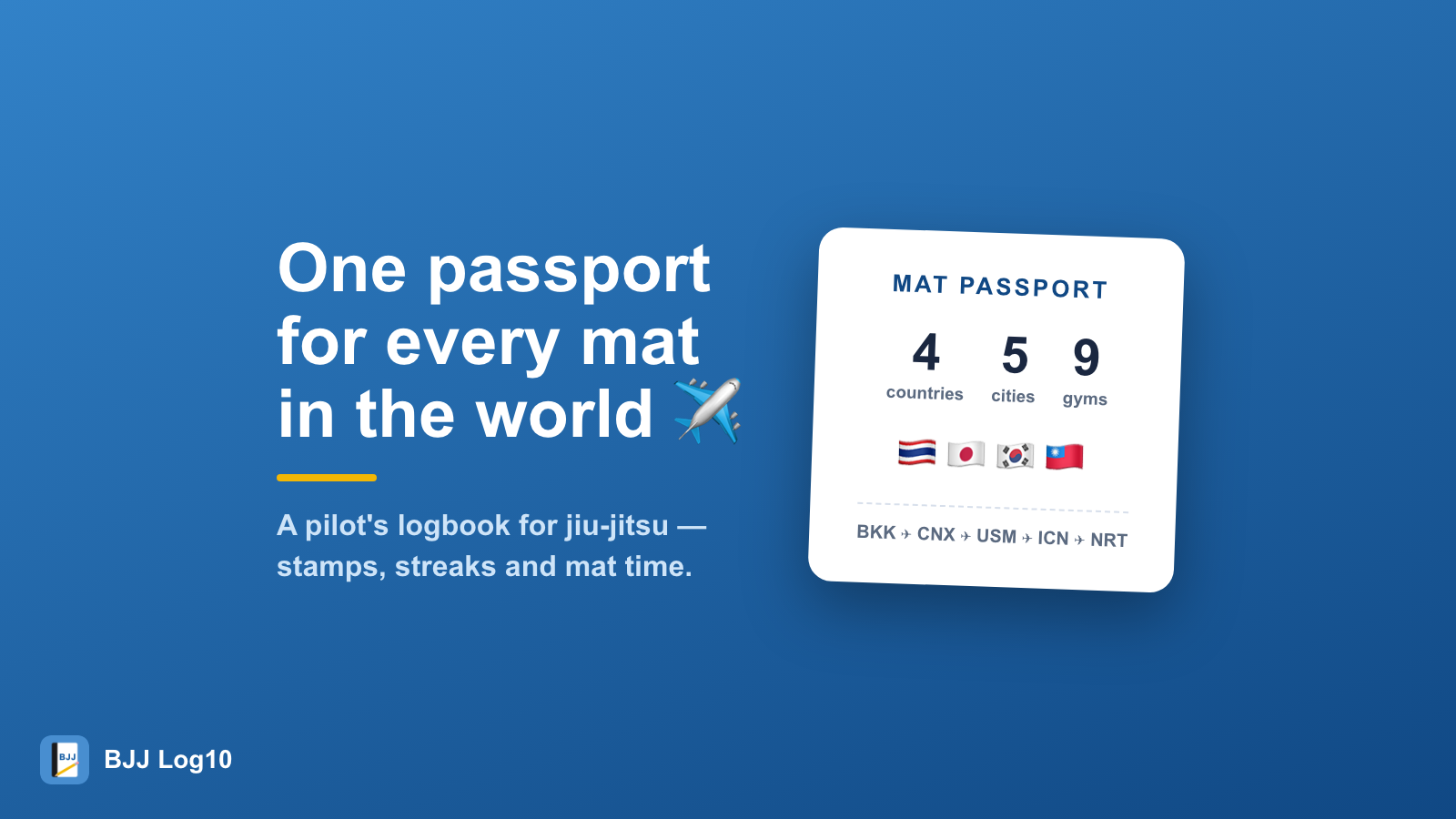
My work schedule has never respected my training schedule. I’m an airline pilot flying around Asia — one week I sleep in three different cities, and the only thing that stays the same is this: wherever I land, I look for mats.
I started jiu-jitsu in October 2018. Like many of you, I promised myself I would keep a training diary. I bought a nice notebook. I wrote in it for exactly two weeks. After that, my jiu-jitsu memory lived in random places — a camera roll full of sweaty group photos, a chat message like “open mat Saturday?”, and a vague feeling that I trained “maybe three times” last month.
The truth is harsher: if you don’t write it down, it slowly disappears. The tap you finally got with the choke you drilled for months. The first time a white belt survived a whole round against you. Your own first round where you survived. These moments deserve better than my memory.
The drop-in life
The drop-in might be the best invention in jiu-jitsu. Walk into any gym on the planet, bow, roll, and you have new friends who just tried to strangle you. My routes happen to cover Asia — Bangkok, Chiang Mai, Koh Tao, Seoul, Tokyo, Taipei — but the magic is the same in London, São Paulo or Austin. Every gym rolls a little differently. Every gym has that one person who taps everybody and then bows politely.
As a pilot I get this experience for free, and somewhere along the way I started thinking of it like a passport. Immigration stamps my real passport; the mats stamp the other one. The problem was, that second passport existed only in my head.
So I built it.
A logbook, because pilots log everything
Pilots are obsessive about logbooks. Every flight hour of my career is recorded — date, aircraft, route, conditions. Nobody asks “did you fly much last year?” because the answer is a number, not a feeling. I wanted the same for jiu-jitsu.
I’m not a professional developer — I’m a pilot who spent his layovers building an app with AI as my co-pilot. The result is BJJ Log10, and the idea is simple: logging a session should take less time than tying your belt. Date, gym, gi or no-gi, how long, one honest note (“got smashed by the small guy again”). Done in seconds.
Then the app does the part my notebook never did. It turns your entries into mat time, weekly streaks and monthly trends. On the first of every month it sends you a small “wrapped” of your training — a calendar where every day you trained lights up blue. And it fills in your mat passport: a world map that colors in as you train in new gyms, cities and countries, with a stamp for every gym you’ve ever rolled at.

For the gyms, too
Along the way something unexpected happened: gym owners started asking for tools. So now managers can take attendance with one tap, track memberships without Excel, and hang a QR poster on the wall — members scan it and today’s session logs itself, no app install needed. Official gyms are already on the map from Bangkok to Tokyo, Seoul and Taipei — and the map has no borders. Wherever you train, your gym belongs on it.
It’s free, it works on any phone anywhere in the world, and it already speaks English, Korean, Thai and Japanese — with more on the way.
The journey continues
If you treat jiu-jitsu as a long journey, not a phase — whether that journey runs through Bangkok, Berlin or Boston — give it a look. Log tonight’s class. In a year, you’ll have a story your memory could never keep.
Media kit & contact